
October 20, 2025
It is almost four months since President Bola Tinubu launched the widely publicized N50 billion worth of farm tractors to boost mechanized agriculture in the country and enhance food security.
Currently the equipment remained idle awaiting federal government directive, exposing Nigeria’s perennial lack of policy implementation, stalled agricultural reforms, bureaucratic bottlenecks, and waste of public resources that undermines productivity.
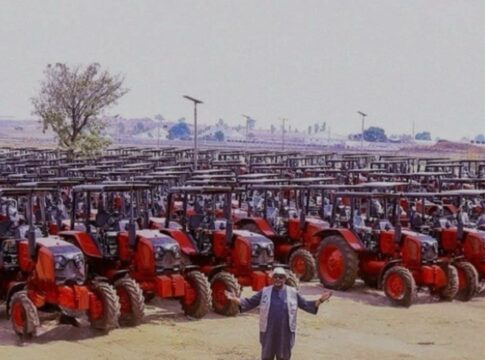
The tractors have continued to gather dust at the headquarters of the National Agricultural Seed Council, NASC. While there are no official details regarding what is stalling the allocation of the agricultural machines imported from Belarus by an ally of president Tinubu.
At the launch, President Tinubu unveiled 2,000 tractors, 2,000 disc ploughs and harrows, 1,000 disc ridgers, 1,200 tractor-trailers, 500 seed drills, 300 boom sprayers, 10 harvesters, and 12 mobile workshop vehicles, among other spare parts.
READ MORE; FG Unveils Agric Reforms With Potential To Create 21m Jobs.
Tinubu, at the ceremony, that had the Deputy Prime Minister of Belarus, Fuad Hussein, and senior Nigerian officials, in attendance, said: “We are taking a monumental leap forward with the introduction of state-of-the-art agricultural equipment under the Renewed Hope initiative. This is a bold step towards achieving complete agricultural independence. I want to make agriculture more attractive to our youths.”
He stated that the equipment would be distributed nationwide to empower service providers, particularly young Nigerians to create jobs and enable year-round cultivation.
Unfortunately, months after the official flag-off ceremony, the Federal Ministry of Agriculture and Food Security says it is still awaiting directives from the Presidency on the modalities for distributing the farm implements.
READ MORE; EU, Nigeria Strengthen Partnership With N320.5b Credit To Support Agriculture.
Speaking in the position of anonymity, a top ministry official, told journalists that delays in approving the sharing formula was holding the ministry from distributing the tractors and other farming equipment.
Another source said only the Presidency now dictates the pace of operations in n the ministry stating that even the officials have little information about the planned deployment of the tractors, aside from what is known at the Presidency.
This situation is currently telling on the optimism earlier expressed by the Minister of Agriculture and Food Security, Abubakar Kyari, when he received the implements in February.
The minister had then announced that the tractors would be distributed through three key models.
According to the minister, the first model would offer direct sales, “allowing individuals and organisations to purchase the tractors outright.”
“The second model is a leasing scheme that makes mechanisation more affordable by enabling farmers to access tractors without full upfront costs of ownership. The third model involves setting up tractor service centres within farming communities, which will enable smallholder farmers to rent tractors as needed for their operations,” he had said.
READ MORE; Food Security: Nigeria, Brazil Sign $1bn Deal to Boost Agriculture.
These models would ensure accessibility and maximise their impact on agriculture, thinking the deployment would take place immediately as the farming season approached, thereby allowing farmers access to affordable labour.
The initiative, according to him, was expected to substantially improve farming efficiency, reduce reliance on manual labour, and contribute significantly to the country’s long-term agricultural transformation goals.
The lack of direction from the federal government, has caused farmers continue to struggle with the high cost of labour, farm inputs, and transportation whilst the farming equipment continue to gather dust and rust away at the headquarters of the National Agricultural Seed Council, NASC.